The Palace of Sweets
Published July 19, 2026 · Confectionally Yours Journal
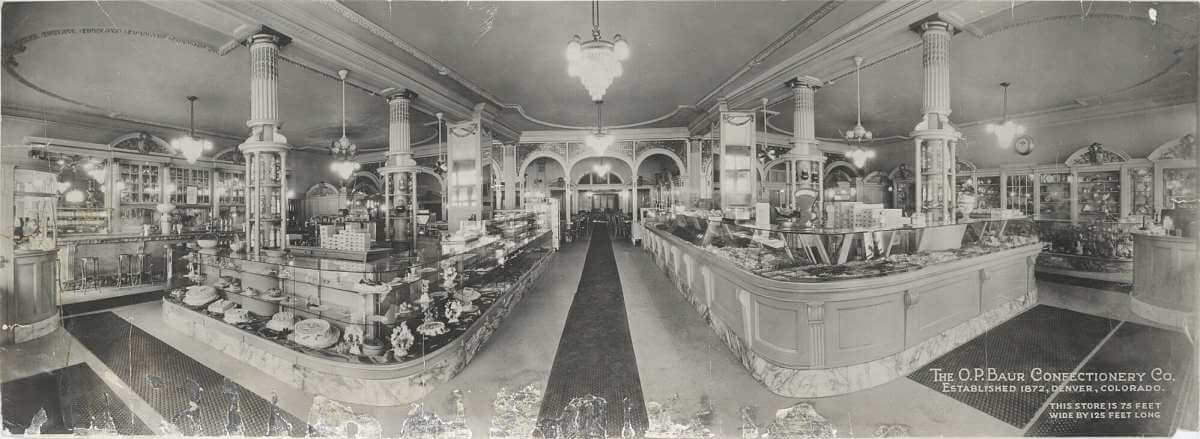
Attribution: The O. P. Baur Confectionery Co., established 1872, Denver, Colorado this store is 75 feet wide by 125 feet long (1890-1910). Denver Public Library Digital Collections, accessed 16/07/2026, https://digital.denverlibrary.org/nodes/view/1033182
There is a photograph of the inside of Baur’s, and the store is so long the camera can barely hold it: marble-based cases running the length of the room, columns rising to a decorated ceiling, chandeliers hung down the center aisle like a hotel lobby. The photographer’s own caption, printed in the corner, can’t resist the boast — seventy-five feet wide, one hundred twenty-five feet long. This was a candy store. People came in off Curtis Street to buy a bag of hard candies and found themselves standing in a palace.
That was the point.
By the time this photograph was taken, confectionery had become spectacle. Somewhere in the second half of the nineteenth century, shopping itself had turned theatrical. The grand European emporiums — Bon Marché in Paris, Whiteley’s and Harrods in London — had discovered that people would come not only for the goods but for the experience of being among them, under chandeliers, reflected in glass. It is tempting to draw a straight line from those marble halls to a candy counter in Denver, and it is probably a mistake to draw it too firmly; Otto Baur was not copying a blueprint. He was drinking from the same cultural spring. The idea was in the air, and it was this: that the ordinary act of buying something could be dressed as an occasion.
Baur was a German immigrant who opened his confectionery and ice cream parlor on Curtis Street in the early 1870s. Est. 1872, the wall would eventually read, painted three stories tall. He was good at the work and better at the theater of it; by the 1890s he employed some twenty people to keep up with the demand for good things to eat. The company would claim, as such places did, to have invented the ice cream soda — an origin story it shared, and contested, with half the soda fountains in America — and the claim mattered less as fact than as posture. Baur’s meant to be the place where things began.
“Unmistakably Yours” — The Palimpsest
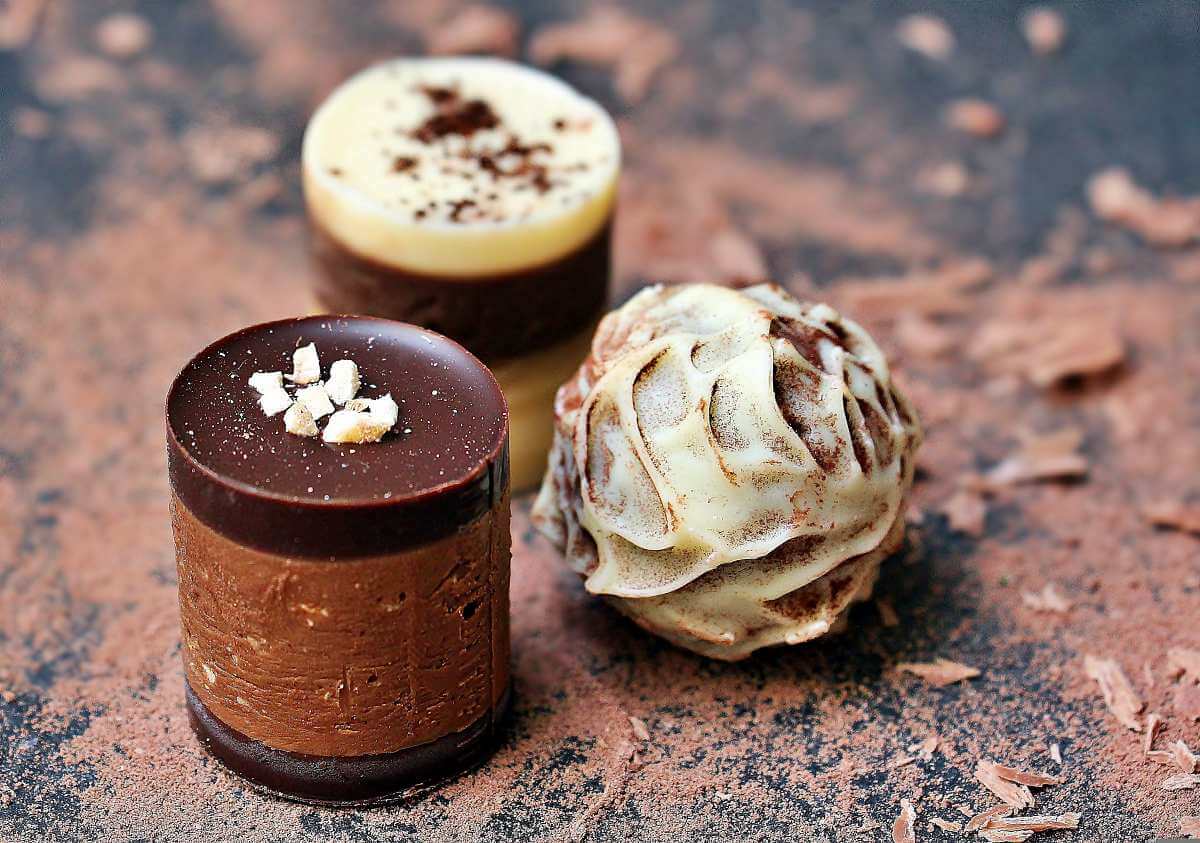
The piece is about blending finished couvertures rather than working from a single house’s library — something small candymakers were doing quietly in back rooms at the turn of the last century, chasing a flavor that belonged only to their shop.
And it looked the part after dark.

Attribution: Rocky Mountain Photo Company, Baur’s Candy Company (1910-1920). Denver Public Library Digital Collections, accessed 16/07/2026, https://digital.denverlibrary.org/nodes/view/1102196
The store stood in the theater district that Denver called its Great White Way, and Baur’s electric sign — the name stacked vertical, blazing letter over letter down the brick — made the shopfront part of the nighttime spectacle. You could ship a box of Baur’s candies clear across the country by then, and many people did, but the sign was for the ones on the sidewalk. It said: something is happening here, and it is happening to you if you come inside.
Behind all of that, of course, someone was stirring a kettle.
The front of the house was chandeliers and plate glass. The back was a man in white work clothes over a copper pot the size of a washtub, paddle in hand, in a room full of pipes and cooling trays. This is where the palace actually lived, and it is worth saying plainly that we do not know his name. The archive didn’t keep it. What the archive kept, instead, was a notebook — because another candy maker wrote his work down. Sol H. Burke kept one through 1942: taffy, caramel corn, peanut brittle, and formulas that read less like cooking than like chemistry, a hundred pounds of sugar turning on a few drops of flavoring. Some of his recipes he marked “war batches,” reworked to stretch the sugar that wartime rationing had made scarce. The spectacle out front was only ever as good as the arithmetic in back.
The palace did not close for any single reason, which is usually how palaces close. The family sold out around 1951, carrying debt. Downtown changed underneath it — rents, parking, the pull of the suburbs, the chain restaurants and supermarket candy that were quietly rewriting how Americans bought sweets. A large, ornate, labor-heavy operation on an expensive block is a wonderful thing until the block stops paying for it. In January of 1970, after nearly a century, the doors on Curtis Street closed.
Here is the part I find myself thinking about. When a place like Baur’s ends, the building gets sold and resold — it has been a restaurant, a listening lounge, a coworking space in the years since — but the knowledge, the thing that actually made it Baur’s, has nowhere obvious to go. And so it scatters. Some of it went to a library: Burke’s 1942 notebook now sits in the Denver Public Library’s Western History collection, catalogued and preserved, war batches and all. Some of it went home in someone’s arms — the shop’s master candymaker, a woman, was given the recipe books when the doors closed, and as far as her family knew, she held the only complete set that ever existed. And some of it simply lived on in the people who had worked the floor: whole families of candymakers who carried the formulas in their hands and their memories.
You can watch them find each other, if you go looking. Beneath the library’s short notice about that old notebook, the descendants have gathered in the comments — a daughter who says her mother was the master candy maker, a family that names five relatives who worked the counters and the kettles across four decades, a grandson wondering whether the candy factory listed on his grandfather’s draft card was this one, someone who still remembers the cities of spun sugar the candy makers built in the windows every Christmas. They are trading fragments in the margins of a webpage, assembling from memory a place none of them can walk back into.
Curatorial Note on Baur’s Founding Date
The founding date carries scholarly ambiguity: sources variously cite 1870, 1871, and 1872. History Colorado’s landmark entry states 1871; the building’s own branding, including the sign visible in the night photograph, reads “Est. 1872”; and at least one source ties the business origin to a partnership with James Colwell around 1870.
The company’s archival collection at History Colorado, MSS.02624, frames the operational span as 1874–1970, suggesting the earliest years may have involved a proto-partnership before formal incorporation. For publication, ca. early 1870s is the most defensible framing.
Baur’s first retail location was at 16th and Lawrence Streets — the site later occupied by the Golden Eagle building. Otto Baur died in 1904, having built the company from a single frontier sweetshop into a regionally renowned confectionery and catering operation.
Sources consulted: History Colorado landmark entry; History Colorado archival collection MSS.02624; The Clio; related historical references.
It is the palace, reconvening. Not the marble and the chandeliers — those are gone, and were always the least of it — but the thing underneath: the recipes, the names, the hundred pounds of sugar and the few drops of flavoring, passed hand to hand, still warm.
“The Palace of Sweets” — Palimpsest | Orphicon