The Long Way to Burlingame
Published November 17, 2026 · Confectionally Yours Journal
The directories
In 1869 a San Francisco city directory lists a man named Etienne Guittard. It gives his trade, his employer and where he slept.
“Guittard Etienne, confectioner with Salomon & Co., dwl 413 Commercial.”1
He was about thirty, he had come from Tournus in eastern France, and he was working for somebody else.
The company that carries his name today says it began the year before, in 1868, on Sansome Street.2 It has said so in print since at least 1921, when its directory entry read “established 1868, trade mark ‘Guitar.’”3 It is a good date and there is no reason to doubt it. A business can trade for years before a directory notices it.
But the directories are what survive, and the directories tell a slower story. Two years after that 1869 line, Etienne turns up again — not on his own, but as a partner in another man’s firm:
“BOURGOING A. & CO., (Etienne Guittard) manufacturers Chartres coffee, chocolate, spices, etc., 526 Washington.”4
E. Guittard & Co. first appears in 1872, at 511 Commercial Street, with a partner named Birgham and a line of goods that will become familiar: “proprietors Eureka Coffee, Chocolate and Spice Mills, and manuf’s Cafe des Gourmands.”5
Every firm that lasts long enough compresses its own past. A company remembers a founding. A directory remembers a sequence of jobs, partners and addresses. Neither is lying.
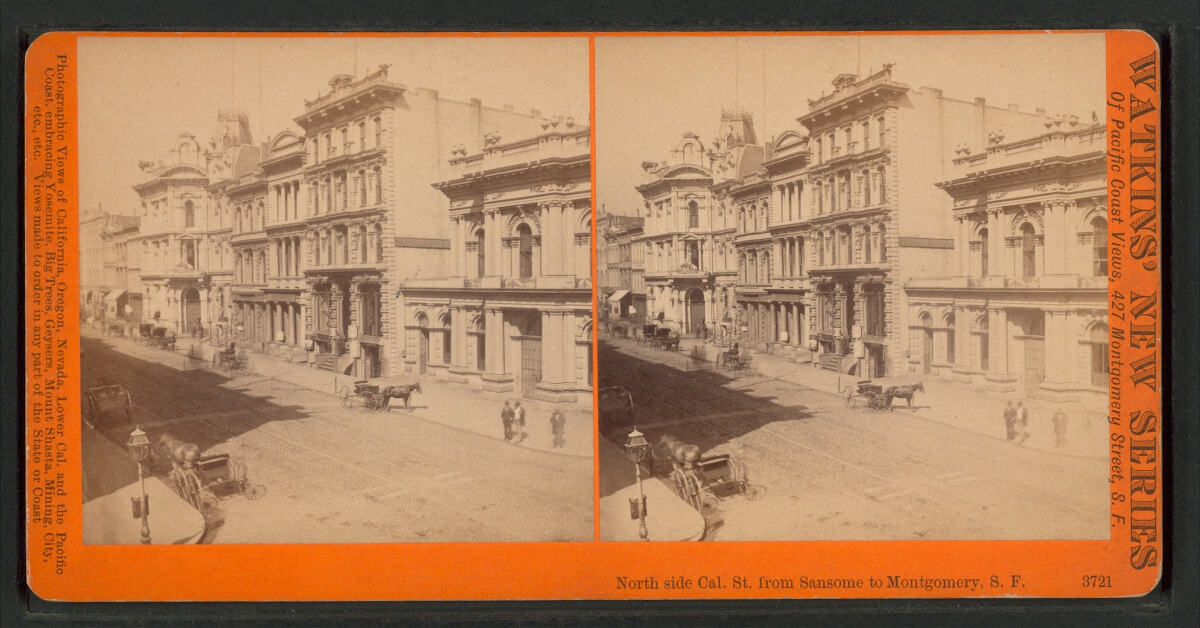
Stereograph of the north side of California Street between Sansome and Montgomery, San Francisco, published after 1873. Ornamented stone-fronted buildings of several stories face a cobbled street where horse-drawn buggies stand at the curb. The card is one of many street views issued under the imprint Watkins’ New Series.
North side Cal. Street, from Sansome to Montgomery, S.F., after 1873. Watkins’ New Series of Pacific Coast Views, no. 3721. New York Public Library, Robert N. Dennis collection of stereoscopic views, MFY Dennis Coll 89-F409. Public domain.
Public-domain stereograph, after 1873, from the New York Public Library’s Robert N. Dennis collection of stereoscopic views. Reproduced as a historical record in editorial and archival context.
Chartres
One word in that 1871 entry is worth stopping on.
Bourgoing’s firm made Chartres coffee. Eight years later, E. Guittard & Co. registered a trademark in Washington for a roasted and ground coffee called Chartres Old Gov’t Java — the sheet this series opened with.
The word Etienne put on his own coffee in 1879 was already on the coffee of the firm he was a partner in by 1871.
Nothing in the record explains it, and none of the sources read for this piece tries to.
What the firm actually was
A reader who knows Guittard today knows a chocolate company. For most of its first fifty years it was something broader and stranger.
It called itself the Eureka Coffee, Chocolate and Spice Mills — steam-powered, by one 1875 account.6 It imported teas from Japan and China. It made baking soda, cream of tartar and saleratus. It sold a patented coffee called Café des Gourmands, a mustard that won a gold medal, and a leavening agent with the magnificent name of Infallible Yeast Powder.
That yeast powder was not only a name. When the Mechanics’ Institute had the leavening agents analysed in 1875, Guittard’s Infallible was measured against the others by name, and the judges recorded that none of the powders tested had been adulterated with alum7 — which tells you what the fair was worried about.
The same 1875 trade notice describes the proprietor at work: “Mr. Guittard is a practical manufacturer, having learned the art in France, and superintends the manufacture of the chocolate in person.”6
And then there is the catalogue, which is where the nineteenth century really shows itself. Alongside the breakfast cocoa and the vanilla chocolate, the house offered a prepared homeopathic cocoa for invalids, and four medicinal chocolates: ferruginous, quinquina, purgative and digestive.6 Chocolate as iron tonic, chocolate as quinine, chocolate as laxative, chocolate as aid to the stomach.
Emery:
Cocoa was thought of as medicine, even as something spiritual, back when nobody could prove what it did. A house selling iron chocolate in 1875 was part of that old belief. Today it gets measured, and it comes out healthy or not.
By 1885 the firm was shipping a collection to the World’s Fair in New Orleans that reads like an inventory of a whole trade: “Prarie Flower Tea. Cafe Des Gourmands. Chocolat Des Dames. Single, Double, Triple Vanilla Chocolates. Homœopathic Cocoa. French Breakfast Cocoa. Sweet German Chocolate. Fancy Chocolate. 34 Samples of Cocoa Beans. Whole and Ground Spices.”8
Thirty-four samples of cocoa beans. The catalogue doesn’t say what made one sample differ from the next.
By 1879 the operation had split in two: a depot at 405 and 407 Sansome, and a factory at 515 and 517 Commercial.9 Sansome was the front of the house — the address printed on the labels, the one the company’s own history remembers. It was never the factory, and the firm was last listed there in 1882.
The other name on the paper
The 1879 directory gives the firm’s partner as Valentine Rey.
He first appears in the firm around 1878 and stays about three years. In April 1880 he and Etienne registered a trademark with the State of California, and the document opens: “Be it known that we Etienne Guittard, and Valentine Rey… have adopted for our use a Trade mark for chocolate.”10
At the foot of that document, Etienne signs for the firm. Rey signs too — as a witness.
By 1881 he is out, replaced by a partner named Dahlmann, and the directory has relabeled him “Rey Valentine, capitalist.” A year later he is in a different trade entirely, as half of Palmer & Rey, type founders, where he stayed until the firm was folded into American Type Founders in 1892. After that the record loses him.
As far as this research reached, the company’s own history does not name him.
There is one more thing about Rey, and it needs to be said carefully, because it is half a fact. In the 1879 directory, two men give the same address at 829 Union Street. One is Valentine Rey of E. Guittard & Co. The other is Jacques J. Rey of Britton & Rey11 — the San Francisco lithographers whose imprint seems to read, in very small type, Britton, Rey & Co. at the bottom corner of the chocolate label Guittard registered in Washington the year before. The directory lists the firm as Britton & Rey.
Two Reys, one address, and a printing firm with the family name on the label.
No source establishes any relationship between them. It may be a coincidence of surname and lodging. It is written here as what it is: a shared address, and an open question.
The bear
The trademark Etienne and Rey filed in April 1880 is the most vivid document the firm left behind, because it describes itself.
“Our Trade-Mark consists of the pictorial representation of a Grisly Bear, back of which on a tinted field is a sun-burst.” Around it, ribbon in a rough hexagon, and in each corner a medal. The words: Guittard’s Exposition Gold Medal Chocolate.
The filing then does something lawyers do and historians are grateful for. It states what could be removed without the mark ceasing to be itself: the tinted field and the borders “may be omitted altogether,” and some of the words transposed or changed, because “the essential features of which are the pictorial representation of a bear and the words ‘Guittard’s Exposition Gold Medal Chocolate.’”
Stripped of everything else, the mark is a bear and a claim.
And then it says where the mark lived, which is the part worth having:
“We have been accustomed to print it upon tinted paper in different colors and wrap it around the cakes of prepared chocolate and also to print it upon show cards, and to print or stamp it on boxes and packages containing chocolate.”
Wrapper, show card, box. The bear went wherever the chocolate went.
The medals in the corners are worth a word. One reads Exposition Universelle 1867. One appears to carry a profile of Napoleon III. One reads 10th Industrial Exhibition. One reads First Premium Awarded to E. Guittard & Co.… 1875.
The Mechanics’ Institute held that tenth exhibition in 1875, and its printed report survives. Under the awards it lists: “59. E. Guittard & Co Best Chocolate.” The judges’ note in the same volume reads: “E. Guittard & Co Chocolate. This is the best exhibit in chocolate, coffee and spices. Diploma.”12
The report records a diploma. The wrapper says Exposition Gold Medal Chocolate, and the 1880 filing registers those words as the name of the product. That is how a house could carry a fair’s praise from the exhibition hall to the wrapper: it made the praise part of what the chocolate was called.
From inside the trade
The record can date a handover. It can’t say what the company was like to deal with. Emery can, a little.
Emery:
Hammond’s, like most small candy manufacturers, was what the trade called a generational customer. We had bought from Ambrosia and from Merckens going back to the days when Carl Sr. ran the company. The commitments in this industry run very deep.
When their western regional man first came calling on us, Jay and Gary Guittard were respected and loved inside their own company. That is not something you can see from outside. You hear it fast from the people who work there.
Losing Jay, who ran the daily operations, was extremely hard on the company and on the family. From what I heard, Gary reluctantly became the heir apparent after his brother’s passing, and he runs the company today.
They took very good care of their staff, and they met their customers on a human level — dinners, chocolate events, time given.
— Emery
Three handovers
The phrase four generations does a lot of quiet work. Here is what is underneath it, in the record.
1899. Etienne Guittard died on July 10, aged sixty-one. Fifty-one years later, the trade press summarised the handover in a single clause: his son Horace C. “assumed his post in 1899 following the death of his father who founded the company in 1868.”13
1950. Horace C. died on April 26, aged seventy-one, after half a century as president. The same obituary carries the next line of succession, and it is not only a son: “The business will be continued by his son, Horace A. Guittard and his son-in-law, Frank S. Timberlake.”13 Timberlake was still chairman eight years later.14 The line held partly by marriage.
1988 and 1989. Horace A. Guittard died in December 1988, aged seventy-six. He left three sons.15 Six months later his son Jay, who had taken the presidency, died at forty-six.
Gary Guittard took over in 1989. He was forty-three. He was still president and chief executive in 2025.16
Four generations have led the firm. A fifth works in it.
The fire, and the fourteen years after it
The story usually told is that the 1906 earthquake and fire destroyed the Sansome Street factory and the company rebuilt as a chocolate maker.
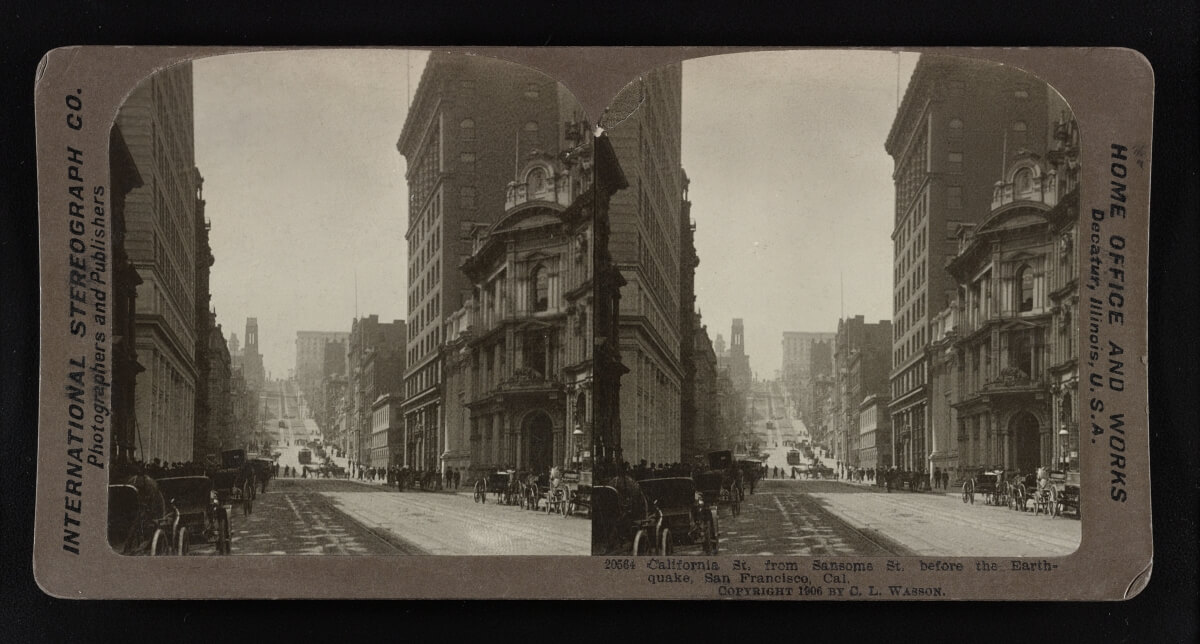
California Street from Sansome Street, San Francisco, before the earthquake: a stereograph published by the International Stereograph Co. of Decatur, Illinois, copyright 1906. The street climbs between tall masonry buildings, with horse-drawn vehicles in the foreground. The card was sold as a record of the street as it stood before April 1906.
California St. from Sansome St. before the earthquake, San Francisco, Cal., c1906. International Stereograph Co. Library of Congress, Prints and Photographs Division, LC-DIG-stereo-1s10714. No known restrictions on publication.
Public-domain stereograph, c1906, from the Library of Congress. Reproduced as a historical record in editorial and archival context. The mount’s printed line “Copyright 1906 by C. L. Wasson” is part of the original object; that copyright has expired, and no rights in the image are claimed.
The directories tell it differently, in two ways.
The firm had not been on Sansome since 1882. It spent the 1880s at 203–209 Sacramento and the 1890s at 107–109 Beale.17 In 1905 it was at 119–121 Front Street; in the 1906 volume it appears at 720–726 Harrison; by 1909 it was at the corner of Clay and Davis, in a building carrying its own name.
And it did not become a chocolate company in 1906. It took another fourteen years. Watch the directory descriptions thin out: in 1909, “teas, coffees, chocolate, cocoa, spice, extracts and baking powder.” By 1916, “chocolate and coffees.” In 1920, at 135–145 Main Street, the entry reads for the first time “Guittard Chocolate Co., chocolate and cocoa mfrs.”18
Read in order, the directories look like a slow letting-go of a grocery trade, across fourteen years and two more addresses, until what was left was the thing the family had always made by hand.
By the accounts available, the last move came in the 1950s, when the city bought the Main Street property to build the Embarcadero Freeway and the company went down the peninsula to Burlingame, where it still is.19
Counting the firm’s own addresses from 1872, that is ten.
What stayed
So: one name, four generations, five if you count the ones at work now, and a street map of a company that could not stop moving.
What is thin is not the company. It is the record of how.
A directory line naming a partner the company’s own history does not mention. A trademark file describing a bear. An obituary in a trade journal that gives a son and a son-in-law in the same sentence. A man at 829 Union Street who may or may not have been related to the lithographer who printed the label.
What a business keeps and what it can document are two different things. Guittard kept the harder one.
This is the second of three. The first read a single sheet of paper — a coffee trademark from 1879 — and what it could prove. The third turns to the trade itself, and to the people in it.
Where the series began
Essay One reads the coffee label E. Guittard & Co. registered in Washington in 1879, and what that one sheet can prove. The sheet itself has its own page in Orphicon.
Essay One — Beyond Chocolate: Guittard’s Coffee Years
Chartres Old Gov’t Java — Guittard Trademark No. 6,991, 1879
Notes
- Henry G. Langley, The San Francisco Directory (vol. “commencing December, 1869”), p. 277, scan 0401. Read from the page image. https://archive.org/details/sanfranciscodire1869langrich↩
- Guittard Chocolate Company, Our History (the company’s own account) — https://guittard.com/our-company/our-history. The 1868 date is also in print in Lewis Francis Byington, History of San Francisco (Chicago: S. J. Clarke, 1931), vol. 3, p. 468, “Horace C. Guittard,” transcribed for the SFGenealogy Golden Nugget Library — https://goldennuggetlibrary.sfgenealogy.org/sfbguit.htm↩
- R. L. Polk & Co., San Francisco City Directory, 1921. https://archive.org/details/sanfranciscocali1921polk↩
- Langley, San Francisco Directory (vol. “commencing April, 1871”), p. 111, scan 0223. Read from the page image. https://archive.org/details/sanfranciscodire1871lang↩
- Langley, San Francisco Directory (vol. “commencing March, 1872”), p. 290, scan 0410. Read from the page image. https://archive.org/details/sanfranciscodire1872langrich↩
- Mining and Scientific Press, vol. 31, 1875. https://archive.org/details/miningscien31unse↩↩↩
- Mechanics’ Institute, Report of the Tenth Industrial Exhibition (San Francisco, 1875), yeast-powder analysis. https://archive.org/details/reportofindustri00mech↩
- Southern Pacific Company, Catalogue of the Products of California (World’s Industrial and Cotton Centennial Exposition, New Orleans, 1885–86). https://archive.org/details/catalogueofprodu00turr↩
- Langley, San Francisco Directory, 1879, p. 384, scan 0456. Read from the page image. https://archive.org/details/sanfranciscodire1879lang↩
- California State Archives, Old Series Trademark No. 0589, “E. Guittard’s Exposition Gold Medal Chocolate,” filed April 12, 1880. Transcribed from the Archives’ eight scans. https://archives.sos.ca.gov/Items/Details/4027↩
- Langley, San Francisco Directory, 1879, p. 735, scan 0807. Read from the page image. https://archive.org/details/sanfranciscodire1879lang↩
- Mechanics’ Institute, Report of the Tenth Industrial Exhibition (1875), awards list and judges’ report, Class LIX. https://archive.org/details/reportofindustri00mech↩
- The Manufacturing Confectioner, June 1950, obituary of Horace C. Guittard. https://archive.org/details/sim_mc-the-manufacturing-confectioner_1950-06_30_6↩↩
- The Manufacturing Confectioner, 1958, listing “Frank S. Timberlake, Guittard Chocolate Co., Burlingame, Calif., Chairman.” ↩
- Associated Press, obituary of Horace A. Guittard, Los Angeles Times, December 30, 1988. https://www.latimes.com/archives/la-xpm-1988-12-30-mn-890-story.html↩
- Stacy Perman, “Tariffs give 157-year-old chocolate maker Guittard a bitter taste,” Los Angeles Times, May 15, 2025, via Yahoo Finance. https://finance.yahoo.com/news/tariffs-157-old-chocolate-maker-100000897.html↩
- Langley’s San Francisco Directory, 1883–1888 (Sacramento Street), and Langley, Crocker and Crocker-Langley directories, 1890–1899 (Beale Street). Internet Archive, e.g. https://archive.org/details/langleyssanfranc1883sanf and https://archive.org/details/langleyssanfranc1890sanf↩
- Crocker-Langley San Francisco Directory, 1909 and 1916 (https://archive.org/details/crockerlangleysa1909sanfrich · https://archive.org/details/crockerlangleysa1916sanfrich); R. L. Polk & Co., San Francisco City Directory, 1920 (https://archive.org/details/sanfranciscocali1920polk). ↩
- Secondary sources only; no primary record of the 1954 sale or the 1955 move has been read. Frederick C. Ingram, “Guittard Chocolate Company,” International Directory of Company Histories (Gale), via Encyclopedia.com — https://www.encyclopedia.com/books/politics-and-business-magazines/guittard-chocolate-company · Guittard Chocolate Company, Our History — https://guittard.com/our-company/our-history · Tara Duggan, “Guittard keeps tradition alive at 150,” San Francisco Chronicle, October 14, 2018 — https://www.sfchronicle.com/recipes/article/Guittard-keeps-tradition-alive-at-150-13302663.php↩
A collaboration of organic and artificial creativity — researched, written and curated with studios that extend what forty years in confectionery taught me. How this is made →
The Palimpsest is the essay room of Confectionally Yours Journal — longer reflections on confectionery craft, lived memory, and the knowledge that lived in people’s hands.
Essays from The Palimpsest, by email. Join the mailing list →