“The Picture Inside the Candy”
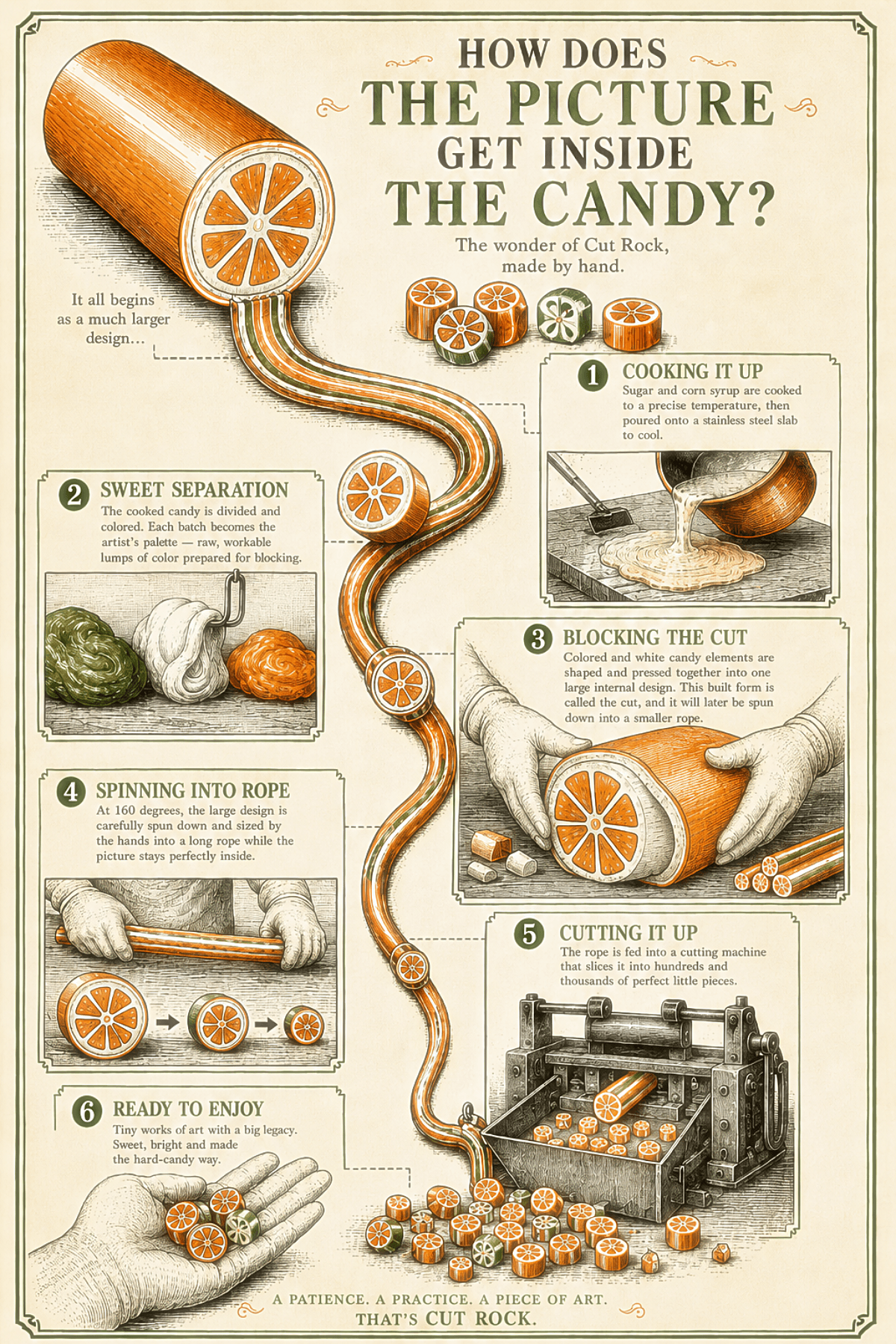
The poster follows Cut Rock from raw sugar to finished piece in six stages, connected by a single continuous rope of candy that winds down the page like the candy itself winds down from a large mass to a small one. It opens with cooking — sugar and corn syrup brought to temperature in a copper kettle, then poured out to cool. From there the cooked batch is divided and colored, each portion becoming what the infographic calls the artist’s palette: raw, workable lumps ready to be shaped into a design.
The center of the piece is blocking — colored and white candy pressed and shaped by gloved hands into one large internal design, built at a scale a person can hold in both arms. This is the step that determines everything: whatever picture lives at the heart of that mass is the picture every finished piece will carry. From there the design is spun down, narrowed under careful hand work into a long rope while the image at its center holds its shape and proportion, shrinking without distorting. The rope is then fed into a cutting machine, sliced into hundreds of identical pieces, each one revealing the same picture in miniature — in this case, an orange slice, chosen as a clear, familiar example of how the design travels intact from the large block down to a single piece the size of a thumbnail.
The infographic closes on an open hand holding several finished pieces, a small, quiet image after five stages of heat, muscle, and precision. Throughout, the poster is illustrated in a vintage engraving style, deliberately evoking the era when this kind of hand-blocked candy work was common practice rather than a rarity — a visual choice that places the technical process inside the same craft lineage the accompanying essay is about.
Image © Nostalgic Confections Creative Studio, 2026
Studio Original (Interpretive Imagery). Editorial authorship & compilation rights. For usage context and visual standards, pair this entry with the project’s current stewardship guidance.
Creativity & Conceptualization
This infographic went through three coordinated AI studios — concept, prompt, and image generation — and two full rounds of correction before it was ready to publish. The first version was aesthetically striking but technically wrong in ways that mattered: bare hands working candy at 160 degrees, a marble slab where our own production uses stainless steel, a blocking panel that showed assembly rather than the sculptural shaping the process actually requires. Getting the vintage engraving style right was the easy part. Getting the craft right took real correction work, cross-referenced against a 1983 Hammond’s booklet, a set of 1960s Hammond archival photographs, and forty years of hands-on memory.
The hardest single panel was Block 3, Blocking the Cut. Every image generator we tried struggled to render the actual geometry — a large unified mass of colored candy shaped and pressed into an internal design, not rods or pieces being assembled like components. We produced a standalone reference illustration of that cross-section that we’re genuinely proud of, but integrating it into the full infographic without disturbing the rest of the composition proved to be beyond what the current tools could do reliably. We made the call to keep the existing panel rather than risk the piece’s overall cohesion, and treated the gloves, the terminology, and the copy as the corrections worth fighting for.
What we learned matters as much as what we produced. Dense, multi-panel infographics with embedded text and panel-specific edits sit at the outer edge of current image generation — closer to restoration work than simple illustration. Our own image studio rated this piece a 9 out of 10 in difficulty. Six hours of collaborative correction later, we landed on something we’re willing to put our name on: publishable, technically honest, and faithful to a process that very few people alive still know how to do by hand.