“The Puncture Test”
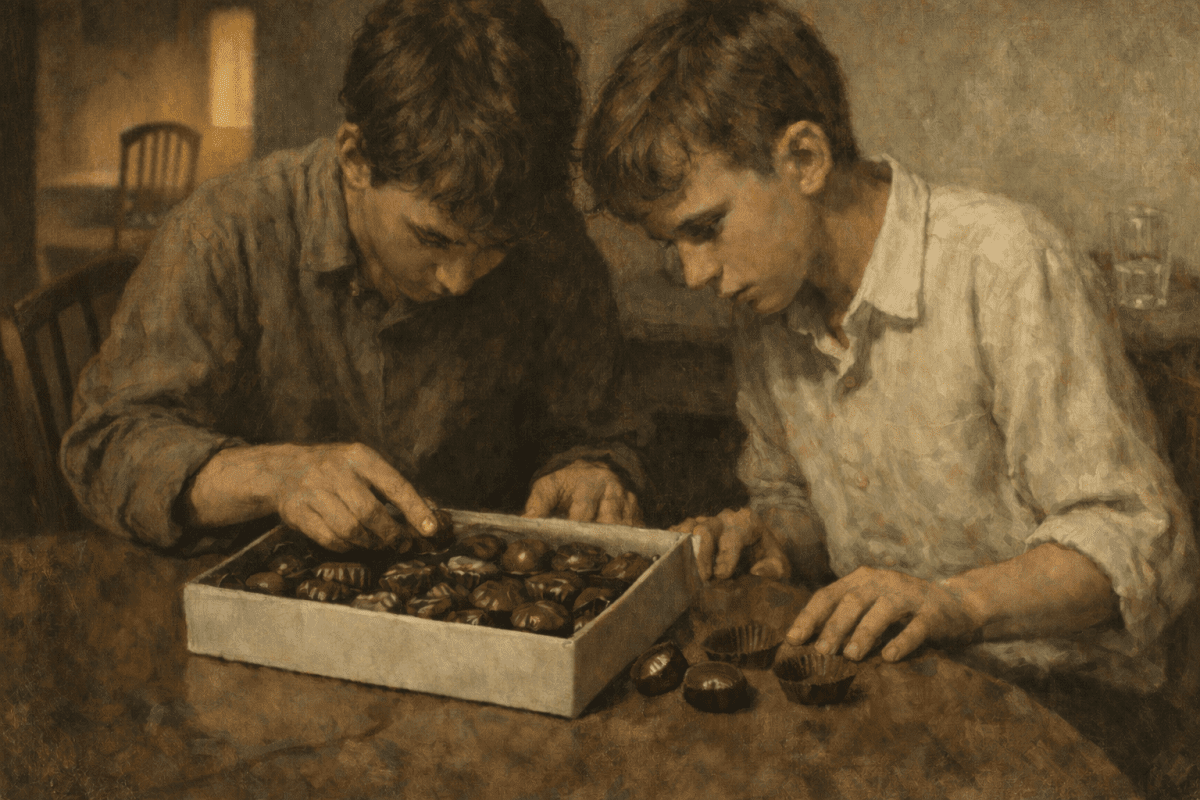
Two boys examine a box of chocolates, testing pieces to discover the hidden fillings — a childhood puzzle that echoes the confectioner’s internal system of chocolate identification marks.
Painterly illustration depicting two boys leaning over an open box of assorted chocolates while attempting to identify the fillings by puncturing the bottoms of the pieces.
The scene visualizes the opening anecdote of the Palimpsest essay “The Puncture Test,” where childhood curiosity encounters the long-standing mystery of the assorted chocolate box.
Image © Nostalgic Confections Creative Studio, 2026
Studio Original (Interpretive Imagery). Editorial authorship & compilation rights. For usage context and visual standards, pair this entry with the project’s current stewardship guidance.
Creativity & Conceptualization
This image emerged from an exploration of quiet human behavior within ordinary domestic life. Rather than beginning with a finished visual concept, the process started with a simple narrative observation: children often approach small acts of mischief with the seriousness of a scientific procedure. The central idea became two boys studying a box of chocolates not as indulgence, but as a problem to solve. The scene intentionally avoids overt humor or sentimentality; instead it invites the viewer to notice the logic of the moment slowly. What first appears as simple concentration gradually reveals a small, carefully managed disruption of order.
The visual construction of the image was shaped through a collaborative studio dialogue that balanced narrative framing, prompt architecture, and iterative visual generation. Each stage focused on restraint. Rather than adding expressive cues, the process relied on subtraction and subtle evidence — disturbed liners, chocolates set aside, and faint signs of testing — to allow the story to emerge indirectly. This method treated the image less as illustration and more as a moment discovered mid-action, where meaning develops through attention rather than explanation.
Creative collectivity played a central role in shaping the final composition. Narrative guidance ensured the emotional tone remained sincere and observational, while prompt design translated that intent into visual structure. Revisions were intentionally incremental: small adjustments to objects, gestures, and spatial relationships allowed the image to accumulate evidence of the boys’ ritual without disrupting the calm surface of the scene. The result preserves the children’s seriousness while allowing the humor to arrive only after the viewer recognizes what is happening.
In this way, the image functions as both a narrative study and a reflection on collaborative image making. The process demonstrates how generative tools, when guided through deliberate conversation and curatorial discipline, can produce scenes that feel less like inventions and more like rediscovered moments. The boys’ quiet experiment with the chocolates becomes a metaphor for the creative process itself — careful testing, small revisions, and the gradual uncovering of meaning hidden beneath an apparently simple arrangement.