“A Small Offering”
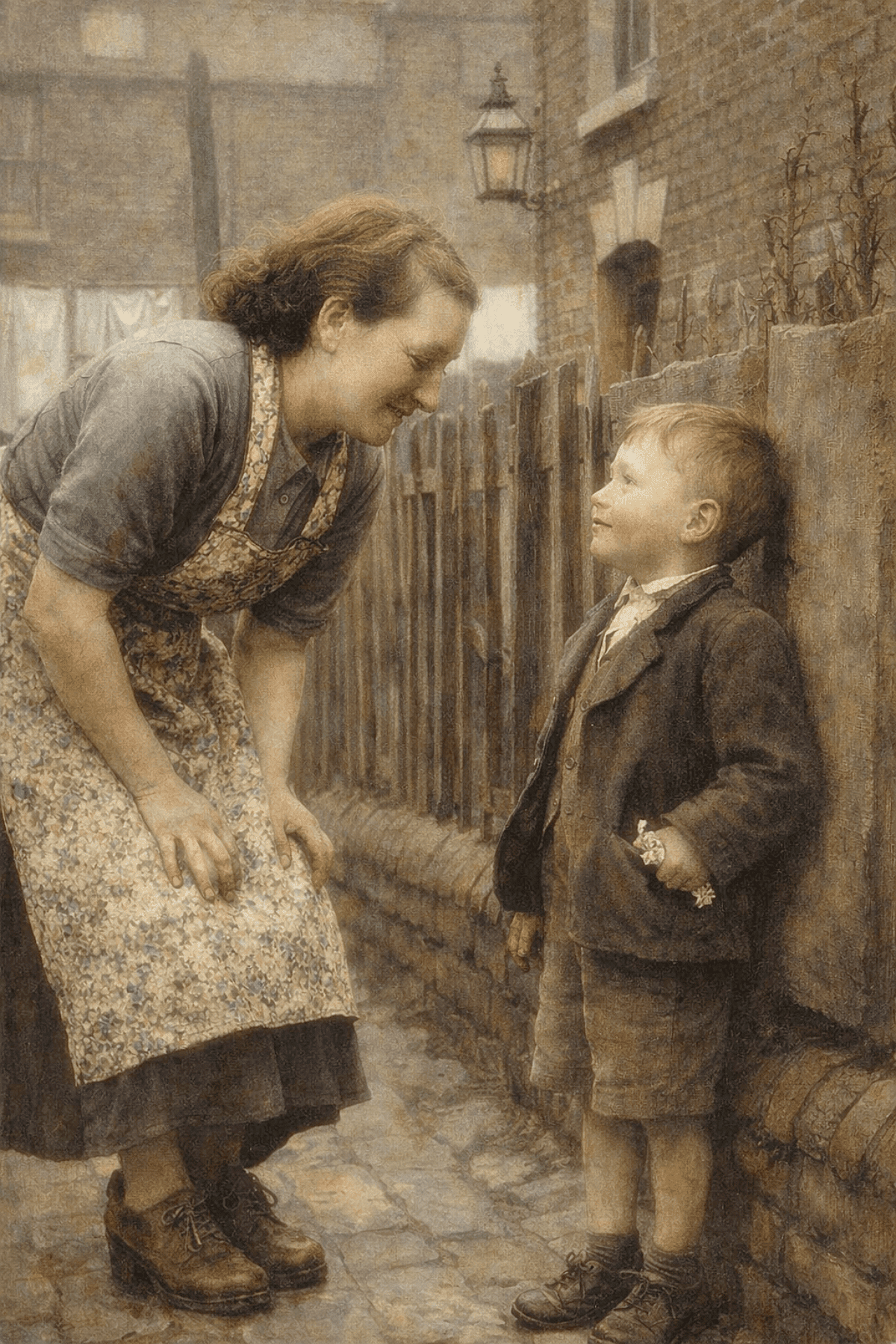
A softly rendered, painterly image depicting a young child standing along a narrow brick-lined street, offering a small object held gently in his hand to a woman who bends toward him with quiet attentiveness.
The setting is modest and enclosed, with weathered brick, a wooden fence, and muted architectural details creating a sense of familiarity and lived experience. The figures are positioned in close proximity, their interaction defined more by posture and presence than overt expression.
The scene captures a brief and unembellished moment of connection — one rooted in recognition, care, and the everyday rhythm of human exchange.
Image © Nostalgic Confections Creative Studio, 2026
Studio Original (Interpretive Imagery). Editorial authorship & compilation rights. For usage context and visual standards, pair this entry with the project’s current stewardship guidance.
Creativity & Conceptualization
This image returns to the earlier foundation of the series — a quiet exchange between child and adult — but refines it with greater attention to emotional realism and restraint. The intent was not to create a sentimental moment, but to capture something more ordinary and believable: a child pausing to offer a small, imperfect gesture, and a mother meeting that moment with warmth rather than surprise. The setting, a narrow brick-lined street, was chosen to support this intimacy — enclosed, familiar, and lived-in rather than picturesque.
The composition developed around body language rather than expression alone. The mother’s posture — bending slightly forward, grounded and attentive — creates a natural point of connection, while the child remains steady, almost formal in stance. The small detail of what he holds, partially concealed in his hand, reinforces the idea of a modest offering rather than a staged gift. Care was taken to avoid idealization: clothing remains simple, proportions natural, and the interaction understated so the moment feels observed rather than constructed.
Rendering focused on achieving a soft, painterly realism that bridges illustration and memory. Edges were gently diffused, textures layered subtly into the environment, and tones kept warm but restrained to avoid overt nostalgia. The result is an image that feels less like a scene being presented and more like a moment briefly witnessed — one defined not by event, but by recognition, familiarity, and quiet human connection.