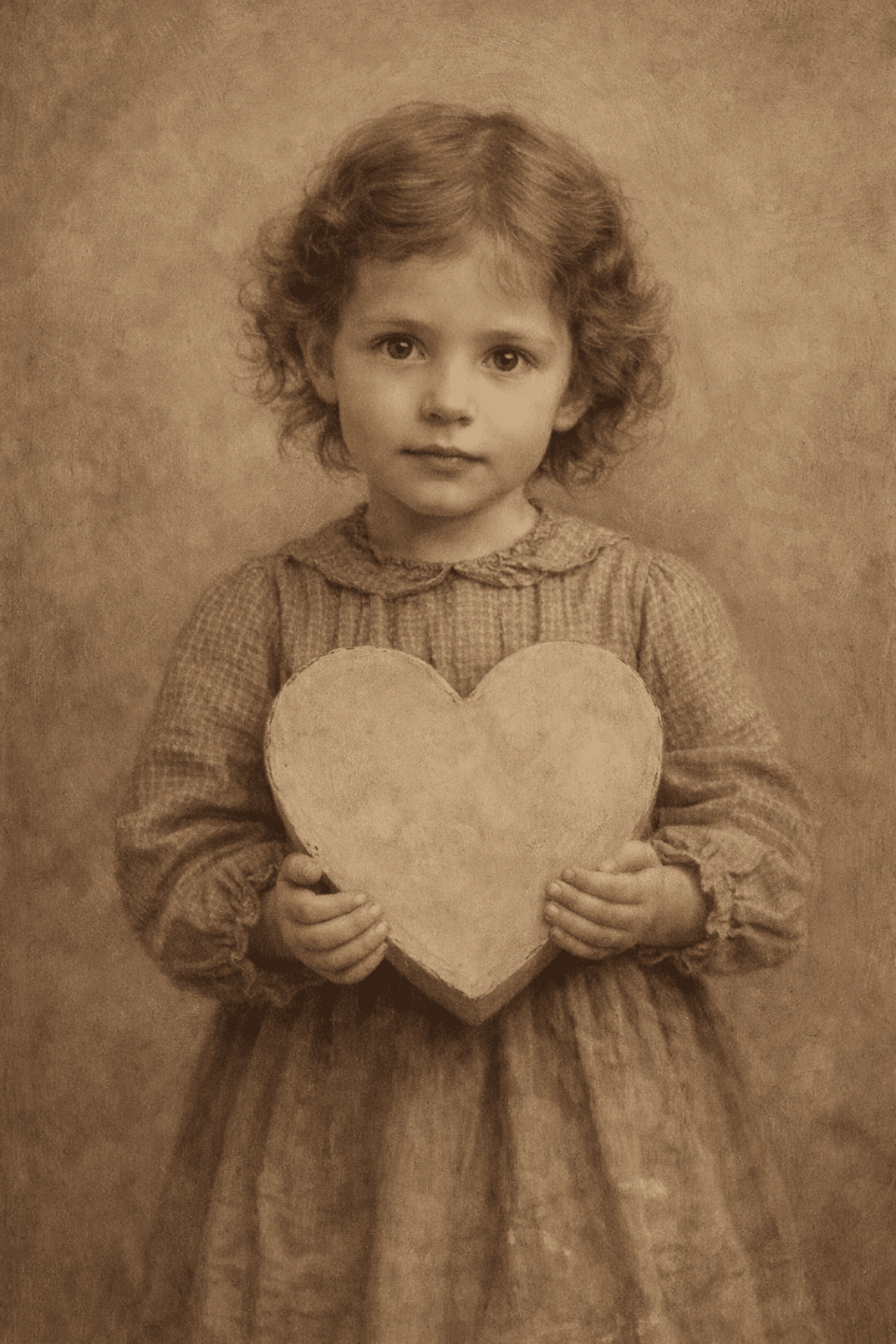
“A Valentine Held (Early 1900s Study)”
This portrait was developed collaboratively within Nostalgic Confections Studio as an emotional and historical reference to early 20th-century Valentine traditions. The composition draws from Edwardian portrait conventions — muted sepia tonality, softened edges, minimal background distraction — and centers on the expressive realism of the subject’s face.
The creative process moved through multiple refinement rounds, with particular attention given to facial structure, gaze direction, and subtle emotional calibration. The final result prioritizes sincerity over ornamentation. The heart is unadorned, deliberately plain, reinforcing the idea that Valentine giving in earlier eras often emphasized gesture over spectacle.
The image is a representation of a possible historical photograph, but also an interpretive homage designed to evoke themes of innocence, offering, and quiet affection within a late 19th–early 20th century visual language.
It is presented as an emotional-historical companion to editorial work exploring Valentine traditions, memory, and domestic ritual.
Image © Nostalgic Confections Creative Studio, 2026
Studio Original (Interpretive Imagery). Editorial authorship & compilation rights. For usage context and visual standards, pair this entry with the project’s current stewardship guidance.
Creativity & Conceptualization
This portrait grew from a quiet shift in the series — moving away from shared scenes of childhood wonder toward a more intimate, interior moment. Rather than depicting action or celebration, the intention was to create an image that feels discovered rather than staged: a child holding a simple heart form, paused in stillness, neither performing nor explaining herself. The heart is treated not as a symbol, but as an object — modest, handmade, and secondary to the presence of the child herself.
The emotional center of the work rests in the realism of the face and eyes. Great care was taken to preserve natural asymmetry, softness of expression, and subtle imperfection so the portrait would feel human rather than idealized. Inspired by early twentieth-century studio photography, the restrained palette and minimal background allow the viewer’s attention to settle entirely on the child’s gaze — calm, direct, and quietly aware.
The result is an image intended to feel timeless: something that might have been found in a drawer rather than created for display. Its meaning emerges not through narrative, but through stillness — inviting the viewer into a moment of recognition rather than sentiment.
